ARTICLE SUMMARY
Knowing how to create a workflow is essential for modern business operations. It involves mapping tasks, connecting systems, and eliminating manual bottlenecks to establish a reliable execution layer. A structured workflow empowers teams to scale efficiently, maintain enterprise governance, and integrate intelligent automation into daily routines.
Operations grow, but management structures often remain stuck in isolated spreadsheets and endless email threads. This scenario creates invisible bottlenecks and forces middle management to manually track every request. Learning how to create a workflow is the first step to eliminating this operational chaos and establishing a reliable execution layer.
When business processes are well-structured, teams reduce rework and gain visibility. A solid foundation is necessary before attempting to scale or adopt new technologies.
In this article, you will discover the essential steps to map, build, and optimize your operations, creating a unified environment for your team. Read more below.
What is a workflow?
Before diving into the practical steps, it is important to define the concept. If you are wondering exactly ‘what is a workflow’, it is a defined sequence of tasks designed to complete a specific business goal.
Unlike a simple task list, a workflow establishes clear rules, handoffs, and responsibilities. It connects different departments and systems, ensuring that information flows seamlessly from the initial request to the final delivery.
How to create a workflow in 5 steps
Building a workflow requires clarity and practical planning. These five essential stages will guide your team from initial mapping to full execution.
1. Identify the problem and define the goal
Start by observing where your operation currently struggles. A high volume of manual follow-ups and lost information are clear indicators of a broken process.
Determine exactly what the team needs to achieve. This clarity is crucial when figuring out how to create a business workflow that addresses real daily frustrations.
Learn more: BPM Processes: How to Optimize, Automate, and Improve Business Workflows
2. Map the current scenario
Document every step, person, and system currently involved in the activity. While spreadsheets can help list initial steps, they are static and lack the execution capabilities needed for a dynamic operation.
Focus on understanding the exact sequence of events, including the exceptions that typically require manual intervention.
3. Build the visual structure
Visualizing the process helps identify redundant approvals and missing connections. Creating a workflow chart provides a clear picture of the entire journey.
If you are unsure how to make workflow chart structures, start by mapping the trigger, the required actions, and the final outcome. Reviewing workflow diagram examples from similar industries can provide valuable inspiration for your own operation.
4. Implement a unified orchestration platform
Moving from paper to a digital environment is what truly brings the process to life. Instead of relying on static documents or isolated tools, adopt workflow automation software like Pipefy to connect systems, data, and people, acting as an agile orchestration layer over your existing core systems (like ERPs and CRMs) without the need to rip and replace them.
As a unified orchestration and automation platform, Pipefy allows business teams to build and automate processes using a no-code interface and native AI Agents, ensuring enterprise-grade governance.
It empowers business users with safe autonomy through IT-established guardrails, freeing the IT department from operational backlogs to focus on strategic innovation.
You can utilize templates for workflow construction to accelerate this phase, setting permissions, establishing service level agreements (SLAs), and delivering measurable operational efficiency in days, not months.
5. Monitor, optimize, and scale
A process is never truly finished. Once the workflow is active, leaders must track performance metrics and identify new areas for improvement. Continuous monitoring ensures that the operation adapts to higher volumes without increasing the manual burden on the team.

How to create workflow automations
Once the foundation is solid, the next logical step is to introduce an automated workflow. Automation takes over repetitive tasks, freeing professionals to focus on strategic decisions. However, true efficiency requires more than just isolated tools; it demands a unified orchestration and automation platform like Pipefy.
Many leaders wonder if ChatGPT can create workflows. While conversational interfaces can suggest process steps, they cannot execute or govern actual business operations.
The market has moved past the Artificial Intelligence hype phase into a demand for proven ROI. True value emerges when AI is orchestrated, not improvised, within a controlled execution environment.
Pipefy solves this by applying native AI Agents that operate under strict corporate governance, eliminating the risks of “Ghost AIs” and ensuring every automated action is trackable, secure, and aligned with company policies.
According to a McKinsey report, Generative AI applied to business operations can add the equivalent of $2.6 trillion to $4.4 trillion annually to the global economy. This impact is achieved by orchestrating intelligent agents alongside human workers in platforms built for scale.
| Process Stage | Manual Operation | Intelligent Orchestration with Pipefy |
| Data Entry | Manual typing and emails | AI Agents extract and fill data automatically |
| Approvals | Unstructured chat messages | Rule-based automated routing with full auditability |
| Tracking | Spreadsheets requiring updates | Real-time visibility and governed execution logs |
Roca Brazil: success case of workflow automations with Pipefy
Pipefy is an AI-powered orchestration platform that enables companies to achieve measurable results in days, not months. A practical example of this transformation is Roca Brazil, a global leader in bathroom solutions.
The organization faced challenges with decentralized information and manual execution in their Human Resources department. Activities like onboarding and administrative routines were handled via email, leading to high operational load and rework.
By implementing Pipefy, the company standardized their operations and introduced embedded AI Agents to handle repetitive tasks.
The results were clear and rapid:
- In just 6 months, the HR team saved over 1,200 hours
- The onboarding process alone saw a reduction of 640 hours of manual effort
- Self-service capabilities saved an additional 147 hours
Pipefy’s AI Agents added a new layer of efficiency to our processes. Just look at the more than 1,200 hours saved on HR tasks. We already use them across several routines, and the goal is to expand that use even further.
Willams Costa
HR Manager at Roca Brazil
This case demonstrates how combining a structured workflow with governed AI empowers business teams to deliver enterprise-grade efficiency, actively reducing the IT backlog and fostering a collaborative, secure digital transformation.
Elevate your operation with an orchestrated and automated workflow in Pipefy
Understanding how to create a workflow is the critical first step toward a more efficient and scalable operation. Connecting disparate systems, human tasks, and Artificial Intelligence into a single control plane eliminates silos and ensures compliance.
Pipefy delivers this capability by offering native AI Agents, no-code simplicity, and full auditability. This approach guarantees that every automated action follows corporate policies, generating immutable execution logs for SOC2 and ISO compliance, and delivering rapid time-to-value for enterprise needs.
If you want to deepen your knowledge and see how this technology applies to your business, we have an exclusive resource for you.
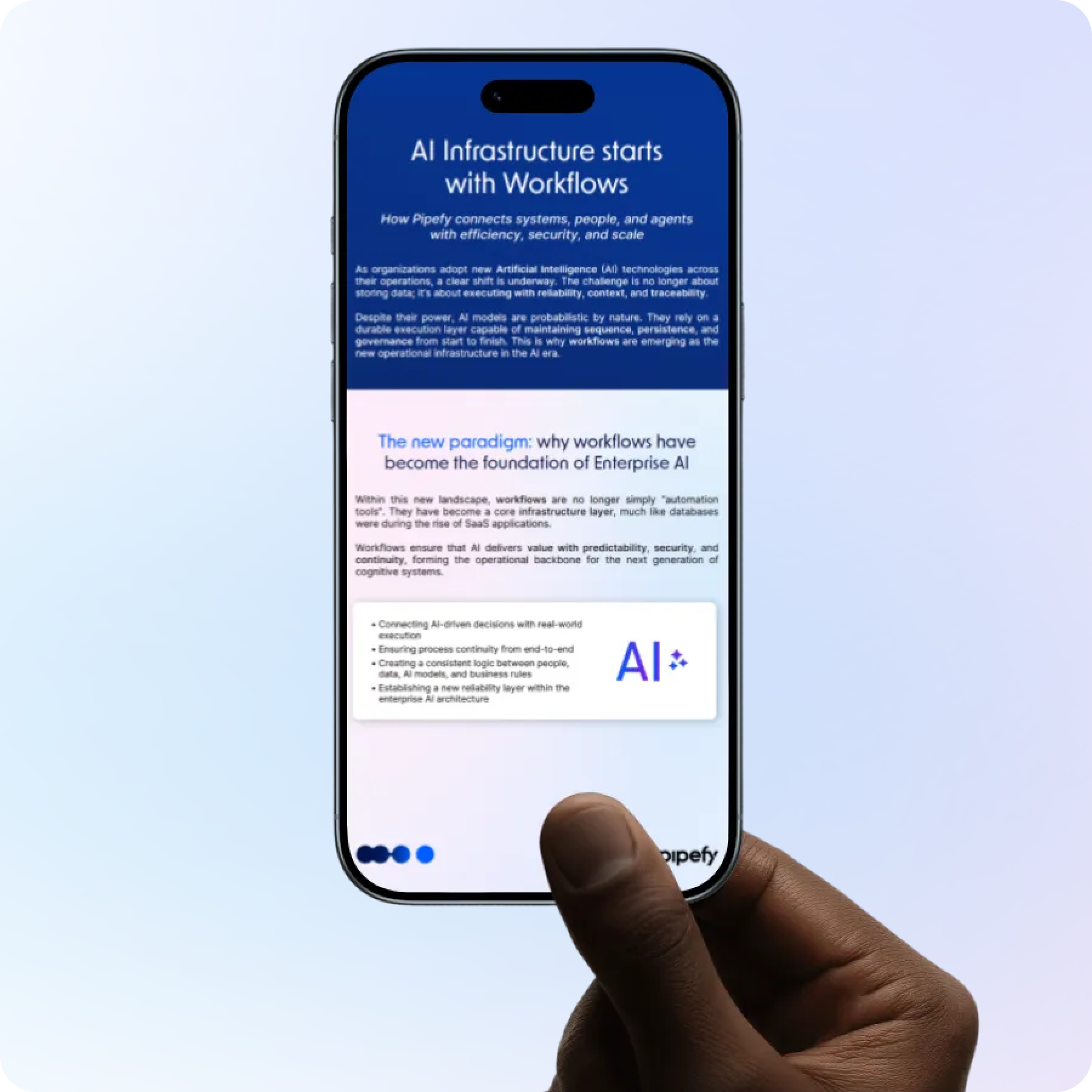
The one-pager “AI Infrastructure starts with Workflows: How Pipefy connects systems, people, and AI Agents with efficiency, security, and scale” explains how to transition from fragmented tasks to unified operational intelligence.
Click the button below to download the material and discover how Pipefy can accelerate your business outcomes:
[One Pager] AI Infrastructure starts with Workflows: How Pipefy connects systems, people, and AI Agents with efficiency, security, and scale